Crown thinning
Selectively removing interior branches so wind and light move through the canopy. This is the single best trim for reducing storm risk on big silver maples and cottonwoods.
Tree trimming and pruning in Fargo. When to trim, how structural pruning prevents storm failure, and how our seasons set the right timing.
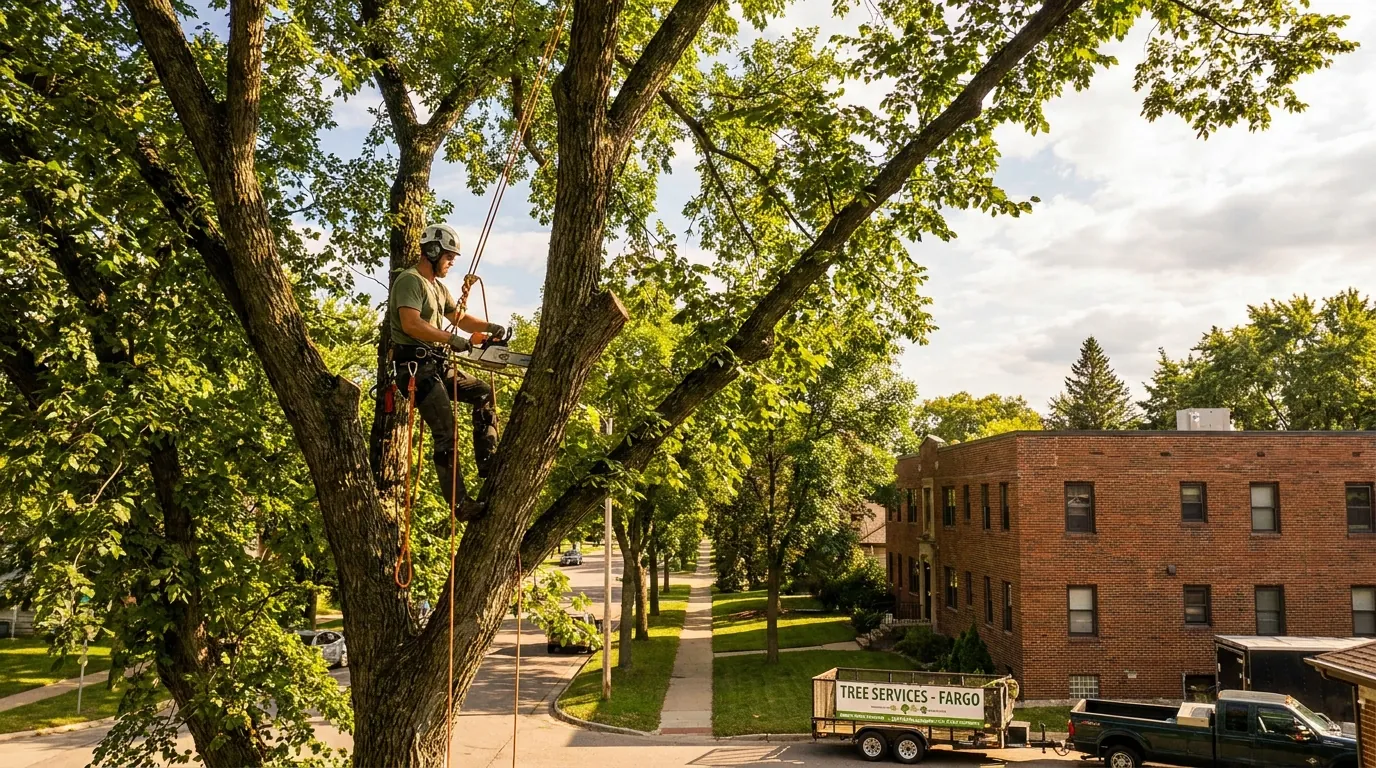
People looking for tree trimming near me usually have a specific problem: limbs over the roof, branches rubbing the siding, a canopy so dense the wind catches it like a sail, or deadwood dropping into the yard. Good trimming solves those problems while making the tree stronger, not just smaller. Done well, it is the cheapest insurance a tree owner can buy against the kind of failure that leads to removal.
Fargo's fast-growing species — silver maple, cottonwood, boxelder — tend to form weak, V-shaped unions that split in high wind. A lot of trimming here is structural: thinning the canopy so wind passes through, removing crossing and co-dominant stems, and clearing deadwood before it falls on its own. The goal is a tree that bends with a valley thunderstorm instead of tearing apart in one.
Different problems call for different cuts. We match the work to what the tree and the site need.
Selectively removing interior branches so wind and light move through the canopy. This is the single best trim for reducing storm risk on big silver maples and cottonwoods.
Taking out dead and dying limbs before they drop. Green ash in older Fargo neighborhoods accumulates deadwood fast and benefits from regular clearing.
Raising or cutting back the canopy to clear roofs, driveways, sidewalks, and power service drops to the house.
Training a young tree early to a single strong leader prevents the weak forks that fail decades later. The cheapest work you will ever do on a tree.
Timing matters in North Dakota. Most hardwoods trim best in late dormant season, before spring growth pushes, when the structure is visible and the tree is not spending energy. Fargo's short thaw window makes that a tight window, so we plan dormant pruning ahead. Light clearance and deadwood work can be done most of the year, but heavy cuts in the heat of summer stress a tree that is already coping with our swing from soggy spring clay to dry July ground.
There is one hard rule worth knowing: avoid pruning ash and oak in the warm months when insects that spread disease are active. We time those jobs around it.
Trimming and removal are not an either-or. Often a tree that someone assumed had to come down just needs an honest structural prune — which is why we usually start with a tree health assessment. And when a tree is genuinely past saving, we move to tree removal instead of pretending a trim will hold it together.
Tell us which limbs worry you and we will tell you what the tree actually needs — thinning, clearance, deadwooding, or just a plan for next season.
Serving Fargo and nearby West Fargo, Horace, Mapleton, Oxbow, Argusville, and Casselton.
Most hardwoods are best pruned in the late dormant season before spring growth begins, when the branch structure is visible and the tree is not under stress. Deadwood and light clearance work can be done through much of the year, but we avoid heavy summer cuts and time ash and oak work around disease-spread seasons.
Done correctly, yes. Crown thinning lets wind pass through instead of pushing against a dense canopy, and removing weak forks and deadwood eliminates the parts most likely to tear off. It is one of the most cost-effective things you can do for fast-growing valley species.
Less than most people expect. Removing too much live canopy at one time stresses a tree and triggers weak regrowth. We prune to a target rather than a percentage of 'cut it way back,' and stage heavy work over seasons when needed.
Sometimes. A tree with good roots and a sound trunk but a messy, damaged canopy can often be restored with structural pruning. We start with a tree health assessment so you are not paying to remove something worth keeping.