Tree Removal — Cost, Process and Scheduling in Fargo
Safe tree removal in Fargo and nearby towns. How removal works, what drives cost, and how our clay soils and hard winters shape the job.
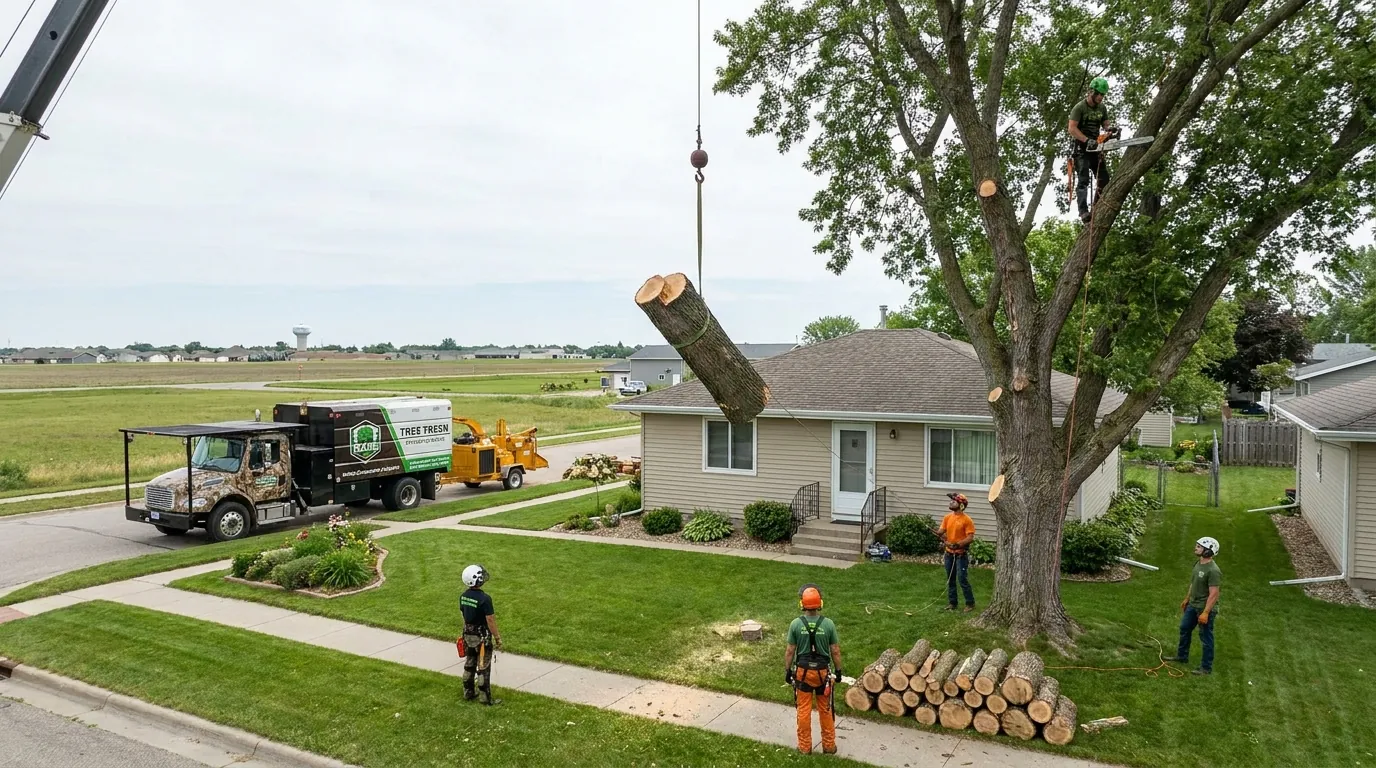
When a tree in Fargo needs to come down
Most people searching for tree removal near me in Fargo are not acting on a whim. They are looking at a tree that leans more each season, a split trunk after a summer storm, or a canopy full of bare branches that never leafed out. Removal is the right call when a tree is dead, structurally unsound, growing into a foundation or power service, or has been so damaged that pruning cannot save it.
Fargo's conditions make these decisions sharper than they would be in a milder climate. Heavy clay soils hold water in spring and crack open in a dry summer, and both extremes stress root plates. Deep frost lines heave the ground around shallow-rooted species, and our short thaw window means a tree that looked fine in October can show real trouble by the time the snow clears. The common species here — green ash, boxelder, cottonwood, silver maple — each fail in their own way, and knowing which failure you are looking at decides whether a tree gets trimmed or taken out.
If you are not certain removal is necessary, a tree health assessment is the honest first step. Plenty of trees that look doomed can be saved with the right cuts, and we would rather tell you that than remove something that had years left in it.
What tree removal actually involves
Removal is a controlled, staged process, not a single cut. Here is how a typical job runs.
-
Site assessment and plan
We look at the tree's lean, the condition of the wood, what sits under the canopy, and how close the house, fence, and power service are. In tight Fargo lots, the plan is usually to take the tree down in sections rather than fell it whole.
-
Setting up a safe drop zone
We clear and protect the area below, account for wind, and plan where each section will land. Clay soil that is soft in spring affects where equipment can sit without rutting a yard.
-
Sectional removal
Branches and trunk come down in manageable pieces, lowered with rigging when needed so nothing swings into a structure. This is slower than felling but it is how removals near houses are done safely.
-
Takedown of the trunk
The remaining stem is dropped or lowered in cuts to a stump height that suits the next step — either flush for grinding or left tall if you want it handled later.
-
Cleanup and hauling
Brush is chipped, logs are cut and removed or left stacked at your request, and the work area is raked out. We can grind the leftover stump the same visit.
How Fargo soil and weather change the work
The Red River Valley's flat, heavy clay is the single biggest local factor in a removal. It holds moisture that softens root anchorage, so trees here lean and uproot in ways they would not on well-drained ground. After a wet spring the soil can be too soft to bring a bucket truck across a lawn, which changes how we rig and sometimes pushes work a few weeks.
Winter shapes the schedule too. Removals are often cleaner in the cold months: frozen ground supports equipment, there are no leaves to haul, and the drop zone is easier to protect. But the short thaw window means hazardous trees discovered in late fall sometimes need to be addressed before freeze-up or they ride out the whole winter leaning over a roof.
Storm damage is its own category. Green ash and boxelder, common across older Fargo neighborhoods, split and shed limbs in high wind. When a storm leaves a tree hung up, cracked, or on a structure, that is an emergency tree service situation rather than a routine removal, and it is handled differently and more urgently.
Not sure if it has to go?
Tell us what you are seeing — the lean, the dead limbs, the cracks — and we will give you a straight read on whether removal, a hard prune, or monitoring is the right next step.
Serving Fargo, West Fargo, Horace, Mapleton, Oxbow, Argusville, and Casselton.
Frequently asked questions
How do you remove a tree that is close to my house?
On tight Fargo lots we take trees down in sections rather than felling them whole. Branches and trunk pieces are lowered with rigging so nothing swings into the roof, siding, or fence. It is slower than a straight drop, but it is the safe method near structures.
Is it better to remove a tree in winter?
Often, yes. Frozen clay supports equipment that would rut a soft spring lawn, there are no leaves to chip and haul, and the drop zone is easier to manage. That said, a hazardous tree should not wait for a convenient season if it is leaning over something you care about.
Will the stump be gone when you finish?
Only if you ask for it. Removal leaves a stump at the height we cut; we can grind it the same visit or leave it. See our [stump grinding](/services/stump-grinding/) page for how that part works.
What drives the cost of a tree removal?
Size and species are the big ones, but access matters just as much in Fargo — a tree over a fence, near power service, or on a yard too soft to drive on takes more rigging and time. We assess all of that on site before quoting.