Emergency Tree Service in Fargo, ND
Storm-damaged, leaning, or fallen trees in Fargo and nearby towns. What emergency tree service covers, how we work safely, and how to decide when to call.
When a tree becomes an emergency
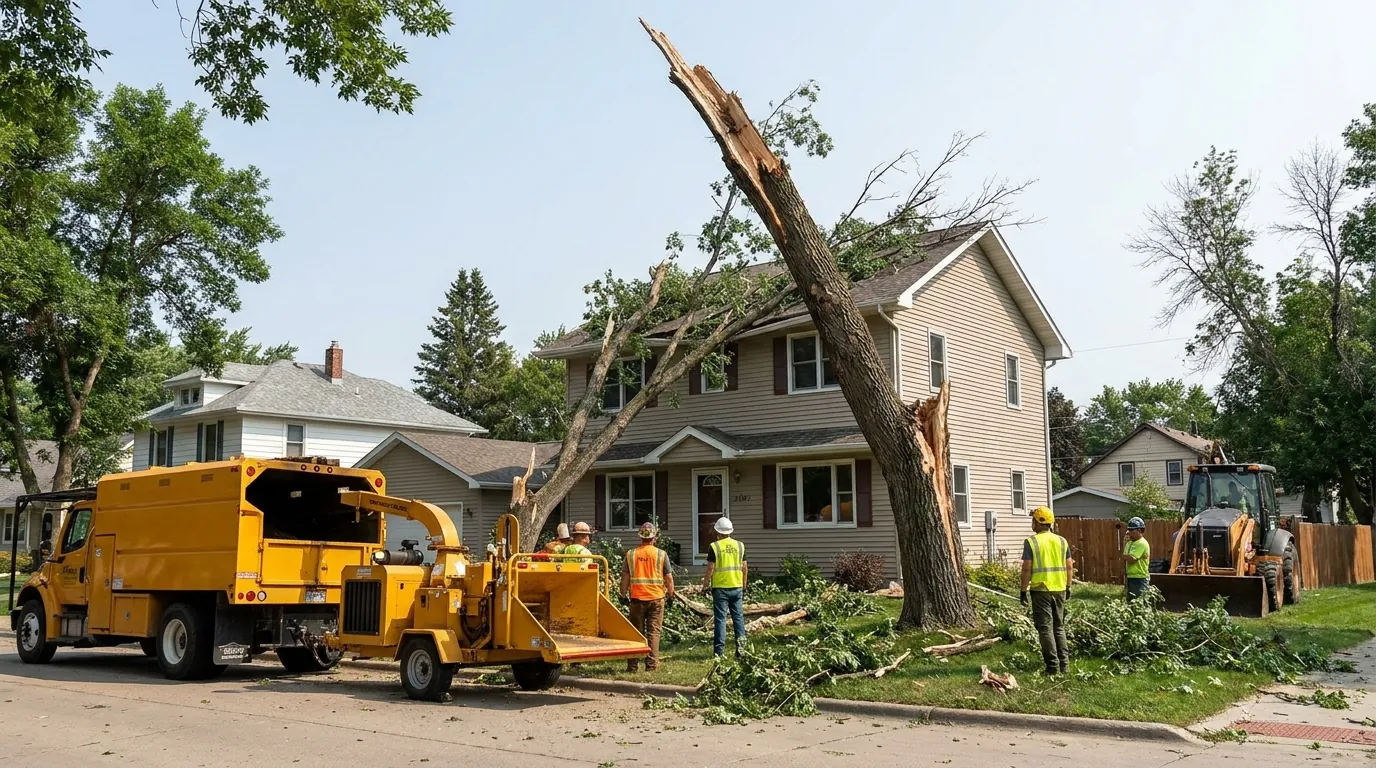
Fargo sits in open prairie country where summer thunderstorms and straight-line winds arrive fast and hit hard. A tree that looked fine in June can split, uproot, or drop a major limb in a single storm. When that happens over a roof, a driveway, a power line, or a neighbor's fence, it stops being a yard project and becomes an emergency that needs careful, prompt handling.
The warning signs are usually clear in hindsight: a trunk that has started to lean after a wind event, a large limb hanging half-detached in the canopy (a "hanger"), a fresh crack running down the stem, soil heaved up on one side of the base, or roots lifting out of the ground. Any of these means the tree has already failed partway and the rest of the failure can follow without warning. If a tree or limb is touching a power line, that is a utility and safety matter first — stay well back and keep others away.
A fast, honest look at the damage tells you whether the whole tree has to come down or whether the hazard can be reduced and the tree kept. That decision overlaps with our tree removal and tree health assessment work, so an emergency visit is often the start of a clear plan rather than a single cut.
How an emergency call is handled
Storm work is about sequencing — reducing the hazard before anyone gets under it.
-
Size up the hazard
We look at what is holding the tree up, where the weight and tension are, and what is underneath it — roof, vehicle, fence, or line. A tree under spring tension behaves very differently from a dead-standing trunk, and the cut order has to respect that.
-
Secure the area
Before any cutting, the work zone is cleared of people and vehicles and a drop zone is established. Hanging limbs are the most unpredictable part of storm damage, so they are brought down under control rather than pulled or shaken loose.
-
Relieve weight and tension
Partial breaks, split crotches, and loaded limbs are cut in a planned order so the stored tension releases where we expect it to, not toward the house or the ground crew.
-
Remove or stabilize
Once the immediate danger is gone, we either finish removing the tree or leave it in a safe, stable state so the full job can be scheduled in daylight with the right equipment.
-
Clear and clean up
Debris is cut down to haulable size and the area is cleared. If a stump is left behind, that can be handled later through [stump grinding](/services/stump-grinding/).
Tree down or leaning after a storm?
If a tree or large limb has failed over your home or driveway in Fargo, West Fargo, or a nearby town, call and describe what you are seeing so we can prioritize the hazard.
If a tree is contacting a power line, keep everyone back and contact your utility first.
Frequently asked questions
What counts as a tree emergency versus routine work?
An emergency is anything where failure is already underway or imminent over something you care about — a leaning trunk after wind, a hanging limb above a walkway, or a tree on a structure. Dead branches you've watched for months are real work but usually can be scheduled as routine trimming or removal.
Should I try to cut a storm-damaged limb myself?
Storm-loaded wood stores tension that can snap a saw back or drop a limb unexpectedly, and cuts near power lines are dangerous. A limb you can reach safely from the ground with a hand saw may be fine; anything overhead, under tension, or near a line should wait for crews with the right rigging.
Will the whole tree always have to come down after storm damage?
Not always. A tree that lost one limb but kept a sound trunk and root plate can often be saved with cleanup cuts. A tree with a cracked stem, a split main fork, or a lifted root plate has usually failed structurally, and a tree health assessment helps confirm which case you have.
Do you work in the nearby towns too?
Yes. We cover Fargo and the surrounding communities including West Fargo, Horace, Mapleton, Oxbow, Argusville, and Casselton, which share the same storm and wind exposure across the open Red River Valley.