Tree Removal Service in Fargo, ND
Tree removal service in Fargo and nearby towns. Removing dead, storm-damaged, or crowded trees safely on heavy clay soils and short thaw windows.
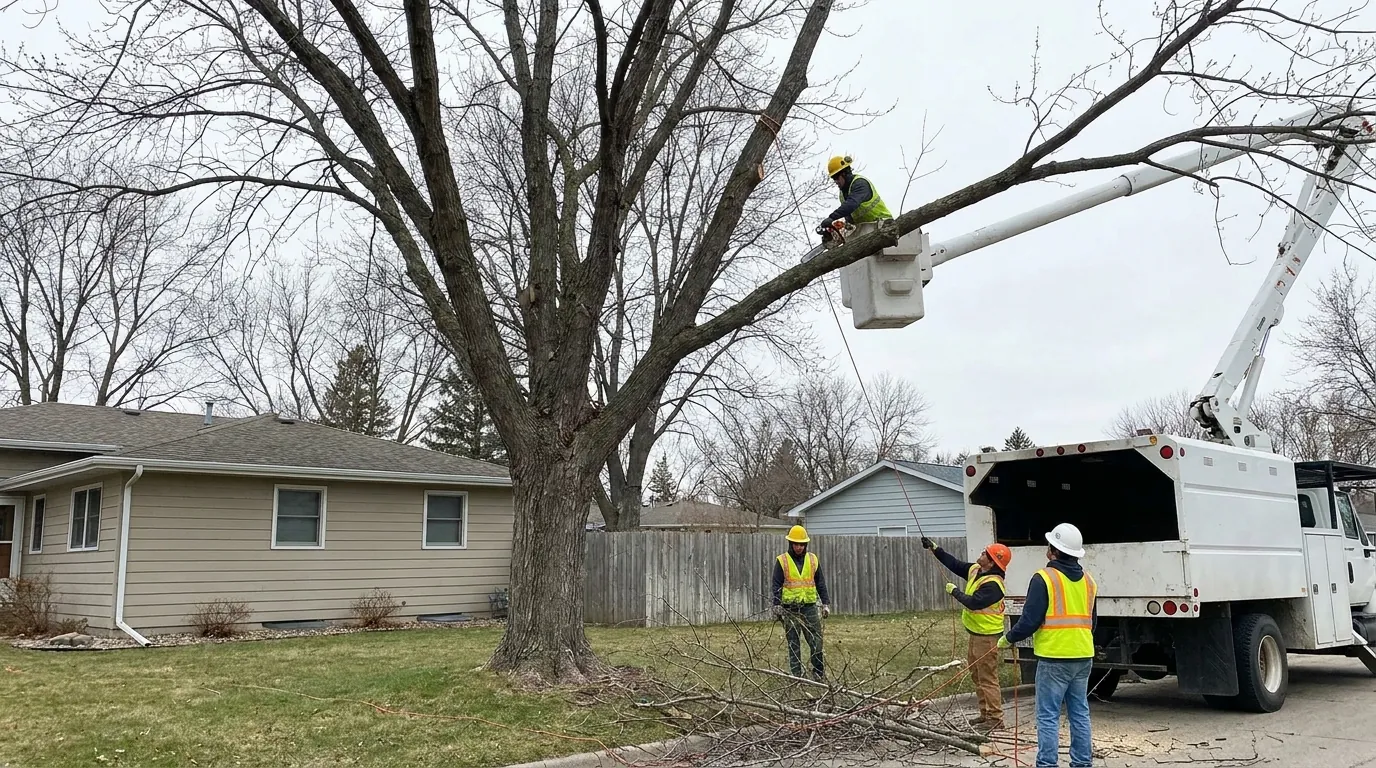
When a tree needs to come down
Not every tree that worries a homeowner needs removal, but some clearly do. A tree that has died back at the crown, split at a major fork, or leans hard toward the house after a windstorm is a different problem than a tree that simply needs a trim. Around Fargo, the trees most often flagged for removal are green ash killed or weakened by emerald ash borer, cottonwoods and silver maples that grew fast and now shed heavy limbs, and boulevard trees whose roots have started lifting driveways and walks. If you are searching for a tree service near me because a tree has you nervous every time the wind picks up, this is the page that explains what removal actually involves.
Warning signs worth taking seriously include mushrooms or conks growing at the base, large sections of bark falling away, cracks that run down the trunk, and roots that heave or rot at the soil line. On heavy clay, a tree that has lost root anchorage can tip in saturated spring ground even if the trunk looks solid. If you notice sudden lean after a storm, cracked soil on one side of the root plate, or dead limbs directly over a roofline or play area, treat it as urgent rather than something to watch through another season.
How a removal is carried out
Removal is a sequence of decisions, not a single cut. Here is the general order the work follows.
-
Assessment and access plan
The tree is looked over for lean, decay, and dead wood, and the surroundings are checked — fences, power drops, sheds, gardens, and how equipment can reach the trunk. On tight Fargo lots, access often decides whether a tree is climbed and lowered in pieces or dropped whole.
-
Clearing the drop zone
Vehicles, furniture, and anything breakable are moved clear. Ropes and rigging points are set so limbs can be lowered under control rather than allowed to fall freely near a structure.
-
Sectional takedown or felling
Where there is room, a tree may be felled in one direction. Where there is not — most backyards and boulevards — it is climbed or reached by lift and taken down in manageable sections, each one lowered or dropped into a cleared space.
-
Wood processing and cleanup
Brush is chipped, logs are cut to length or hauled, and the site is raked. What remains is the stump, which is handled separately by grinding if you want it gone.
How Fargo conditions change the job
The Red River Valley's deep frost line and heavy clay soils shape both timing and method. In winter, frozen ground carries equipment well and protects lawns from rutting, which is one reason some removals are scheduled for the cold months. During the short thaw window and through wet spring stretches, saturated clay turns soft, and heavy machinery can leave deep ruts or get stuck — so ground protection or a delay is sometimes the smarter call.
Clay soil also affects how trees fail here. It holds water and drains slowly, so root rot and poor anchorage are common in low spots and near downspouts. A tree that looks healthy above ground can have a compromised root plate below it, which is why lean and heaved soil matter so much in this area. Once a tree is down, many homeowners follow up with stump grinding and repair to close out the site, or plan a replacement planting for the spot. For work that spreads to nearby standing trees, see our tree removal service overview on the home page.
Get a look at your tree
If a tree has you concerned, describe what you are seeing and where it sits on your property, and we can talk through whether removal is the right step and how it would be approached.
Serving Fargo, West Fargo, Horace, Mapleton, Oxbow, Argusville, and Casselton.
Frequently asked questions
How do I know if a tree needs removal or just trimming?
A tree with structural cracks, major dead sections, root rot, or a new lean after a storm is usually a removal candidate, while a healthy tree with a few problem limbs can often be trimmed. If the concern is a hazard over your home or the tree is more than half dead, removal is generally the safer choice.
Is winter a good time to remove a tree in Fargo?
Often, yes. Frozen ground supports equipment and reduces lawn damage, and bare trees are easier to assess and rig. That said, emergency removals happen in any season when a tree becomes an immediate hazard.
Will removing a tree damage my lawn?
The goal is to avoid it, and much depends on ground conditions. On soft, thawing clay, heavy equipment can rut a yard, so work may be scheduled for firmer ground or done with mats and ground protection.
Does the price include stump removal?
Removal and stump grinding are usually priced separately, since not every homeowner wants the stump ground. Cost drivers include tree size, access, proximity to structures, and how the wood is handled.